Last updated on 2nd December 2025
Delivering a personalised guest experience at scale is now possible. We’ll explore how growing short-term rental portfolios are redesigning their guest facing infrastructure to make it happen.
A Maturing Segment: Short-term rentals are now a clear and established segment of hospitality with its own set of challenges being addressed by the industry specific solutions coming to market, meeting the needs of the modern day property manager.
The Modern Travellers: The fragmented short-term rental market has worked heavily in favour of operators, driving innovation and levels of service. Speed over personalised messages up until recently was a common dilemma. Today, tools plug into your PMS and WhatsApp to learn your tone, leaving you to progressively unwind the leach.
Frequent Challenges: Missed calls, communication bottlenecks, inconsistent tones, lack of coverage outside business hours all contribute to inconsistent reviews.
Key Objectives: Understand your communication structure. Studying how and where automation can be applied. Documenting communication standards for your team to follow. Measuring the results of your communication system.
Takeaways: Guests expect a fast and reliable service, equipping teams with the right tools has never been more important. Where emotional and situational awareness become the differentiator, cutting repetitive tasks is priority. Mapping out your current communication flows will deliver consistent reviews, repeat stays and owner confidence.
Frequent Communication Challenges in Short-Term Rentals
Teams find themselves delivering the same information to guests, hit a breaking point during peak season leading to staff leaving their roles shortly after the end of the busy season.
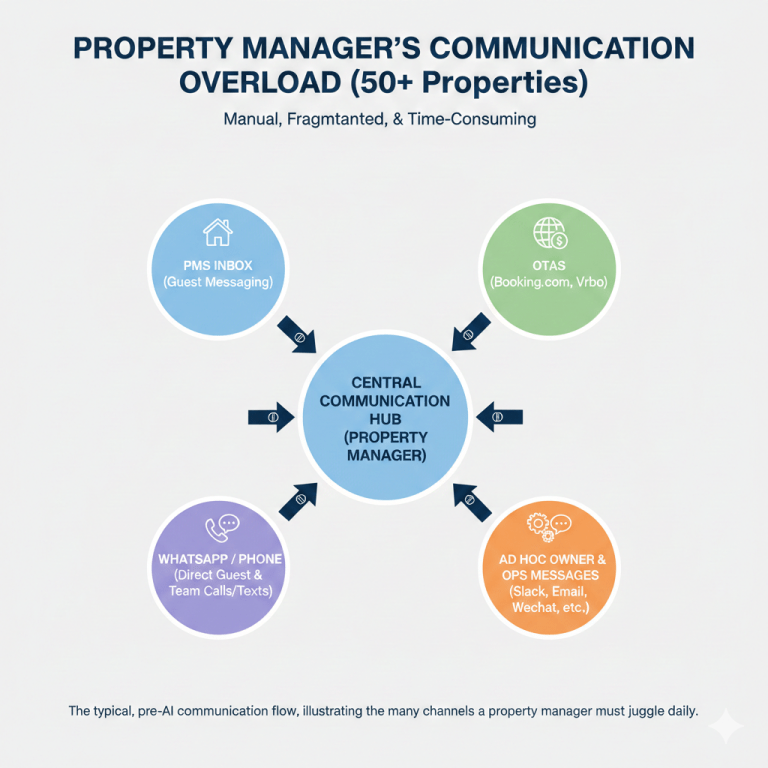
The Current Communication Stack
Prior to the advent of these purpose built tools the typical setup looked like the following:
PMS inbox + OTA + WhatsApp/Phone + Ad hoc owner and Ops messages
As your short-term rental portfolio grows, your operational infrastructure will do so accordingly. A growing headcount keeps margins thin, and profitability a challenging. Fragmented tools, a lack of training creates coordination issues. Making for unnecessary stress and exhaustion.
Channel and Tool Consolidation
What used to require a team of 8 can be achieved with half the headcount.
Keeping up to date property information will save your team repetitive guest interactions rather than dealing with the exceptions.
Hospitable alone was responsible for sending over 12 million automated messages in 2023 saving short-term rentals 24 years in manual messaging.
Despite this, more granular information was still a point of friction faced by short-term rentals. In come messaging layers, applications like of EnsoConnect consolidating text based communication, automating guest messaging, offering digital guidebooks, extending coverage to 24 hours whilst storing vital information like:
Lockbox codes, Directions to the property, Code to the Wifi, Nearest parking, Offers and Upsells.
Voice AI for Short-Term Rentals
Voice AI offers a more intimate medium of communication for guests. With 24/7 assistance, voice AI improves first call resolution rates, treating every call and lowering response times.
Voice AI for short-term rentals integrates with property management softwares supporting VoiP solutions like Twilio and Aircall. PMS integration is essential for your voice agent to update in real time.
Voice AI for Short-Term Rentals Can Assist Throughout the Guest Journey
Process Bookings
Allow your voice agent to access your listings and reservations to turn enquiries into bookings while you sleep.
Pre Check-In
Verifying guests booking details, information about the property, check-in time and shuttle services if offered within your list of services.
Mid-Stay
Checking on your guests ensuring they’re settled in, addressing issues, and recommending local activities. A service not previously possible due to teams being stretched thin, adding an extra touch point contributing to an enhanced guest experience.
Emergency Line
During emergencies its natural we’d want to call in search for a fast response, which makes voice AI a necessary addition to your tools.
Using Voice AI
Voice can act as a filter, sorting requests, leaving your team to handle the most important scenarios. Voice AI systems tracking analytics, guest sentiment helping short-term rentals refine their service delivery in real time.
Specialised voice AI tools like CONCIAIRGE study your tone and responses to FAQs, further adapting to situations. Voice AI solutions are capable of speaking in over a dozen languages making guests’ interactions even more personal.

Standardised Journeys and Messages
The object of the task here is to map out each stage of the guest journey:
Enquiry -> Booking -> Pre-arrival -> Arrival -> In-stay -> Pre-checkout -> Post-stay
Defining the Role Communication Plays
(reassure, inform, upsell, gather feedback, request reviews).
Structure a message map of key and frequent information you should send at each stage and on which systems they should be sent from. Sending the same relevant information across stages e.g where the lock box is located is a smart move according to Home Team Luxury Rentals seeing strong correlations with higher review ratings.
Segmenting
Property managers catering to different guests, can also add a layer of segmentation emphasising different elements of the stay such as local co-working spaces for corporates and child friendly restaurants for families.
Example: The entire booking process can be handled. Following that event, 24 hours before arrival we can contact with options for transport services, facts about the area. On day 1 we check their time of arrival, check for last minute changes etc.
Standard Responses and Escalation Paths
Standard responses play an important role in a short-term rentals’ process allowing to scale by turning what is often seen as a personal skill to a system the business owns.
Defining response times and standards per channel
Giving your team measurable standards to adhere to is a good way to ensure quality is met. For example: Replying to OTA messages within an hour during business hours. Clear and actionable targets will ensure your team is set for success.
Clarify Ownership
Defining who looks after which channel who has authority to make goodwill gestures builds ownership within teams and limits confusion and messages slipping through the cracks.
Setting Escalation Paths
Defining which issues can be fully automated. What site managers handle and what escalates to ops, maintenance or leadership (e.g. hazardous issues, serious complaints, PR-sensitive incidents).
Setting the Standard
A straight forward playbook exemplifying how the PMC communicates with standard responses. The object is training on your operating standards.
Automation with a Human Touch
Automation is the next step to getting the most value out for your team. Making face-to-face interactions, recommendations or owner relationships the focus of their work.
Automate Predictable Interaction
Pre-arrival information, check-in details, links to your guidebook, mid-stay check-ins, checkout instructions, requesting reviews are worth implementing. This will dramatically reduce your number of queries and phone calls.
Allow Room for Human Judgement
Training your team to recognise when the human touch is required e.g. safety issues, complex directions or special requests outside the scope of your operations.
Use Voice AI as a Front Door, Not a Wall
As short-term rental operations grow, safeguarding staff resources plays an important role in retention. As such having systems to answer routine questions and capture intent, routing nuanced cases to a human agent with the needed context. This aligns operators with guest expectations for fast responses giving your brand a “white glove but always available” feels.
Continuous Refinement
Using patterns in guest questions, reviewing comments to improve wording, timing can make your responses more effective over time.
Measuring and Collecting Feedback
Like any other process, communication should be measured, reviewed and optimised.
Selecting KPIs
Average response time by channel, first-contact resolution rate, communication ratings in reviews, number of guest messages/calls per booking, mentions of “easy communication” in reviews. Tracking these metrics have shown a direct correlation with revenue, ranking and repeat bookings.
Building Simple Feedback Loops
Reviewing messages and reviews to spot points of friction is a straightforward way of finding areas for improvement. Adding information to your guidebook, pre-arrival message or adjusting your automations can ensure operations run smoother.
Tying Metrics to Actions
For example, if messages at the time of booking are high, pre-arrival information may require added information. If response times are higher than hopped, adjusting staffing or adding automations could be the right course of action.
Sharing Results
Show how better communication drives better reviews. This can help justify investment in tools and training, aligning owners and team members around a clear standard.